St. Yrieux
The Best Werewolf Short Stories 1800-1849St. Yrieux is a town in the dangerous parts of ancient Poictou, situated in the Upper Limousin, where the countryside’s forests and local superstition provide the setting for a major werewolf narrative. Its importance lies in the way it joins material decline to imaginative terror: an old country-house falls into decay, impoverished outsiders live in near silence, and the townspeople transform nocturnal sounds and unexplained violence into evidence that a Wehr-Wolf inhabits the surrounding woods.
Setting and Physical Character
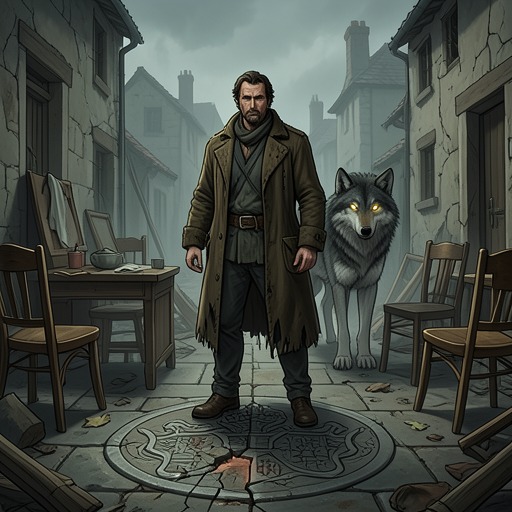
St. Yrieux is presented as a retired town on the edge of a hilly and wooded district associated with the Wehr-Wolves, the creatures also called Bisclavarets or Loups Garoux. The town stands near forests in which the supposed monsters wander at night, howling through the streets of neighboring villages. Its remoteness is not merely geographical. Much of its population is unemployed, and the inhabitants are described as habitual gossipers and lovers of wonders, conditions that make the town especially receptive to extraordinary explanations.
A principal landmark is the old, handsome Maison-de-Plaisance belonging by hereditary right to the young Baroness Louise Joliedame. She lets the Chateau to strangers because of her fear of the Wehr-Wolves, her horror of its old-fashioned chambers, and her stronger attraction to the court of Francis I. Only a small portion of the mansion is occupied; the remainder is left unrepaired and rapidly decays. The building therefore functions as both lodging and Gothic enclosure, preserving the atmosphere of an abandoned past while sheltering people whose identities and histories are uncertain.
Residents and Social Life
One tenant is Doctor Antoine Du Pilon, a country surgeon who claims knowledge not only of the sciences associated with Galen and Hippocrates but also of Alchemy, spirits, and Magic. He spends abundant leisure at the Chevalier Bayard’s Arms, the little Cabaret of St. Yrieux, where he gathers Cuirbouilli the Currier, Malbois the Joiner, La Jacquette the Tailor, Nicole Bonvarlet the Host, and other gossips. At the end of their conversations, they regularly acclaim Doctor Antoine Du Pilon as the best doctor and wisest man in the world, although his medical record includes keeping old Genifréde Corbeau cold and fasting and nearly amputating Pierre Faucille’s leg when the reaper had injured his arm.
The cabaret becomes the town’s unofficial chamber of interpretation. When reports of the Wehr-Wolves spread, the inhabitants meet there under the pretense of protecting one another. They repeat frightening stories, enlarge them through false additions, and often become too terrified to leave, deciding to spend the night around Nicole Bonvarlet’s wine flask and blazing fire. Doctor Antoine Du Pilon supplies the gathering with learned authorities, sacred and profane, so that the town’s fear acquires the appearance of scholarship. In St. Yrieux, conversation does not dispel superstition; it gives superstition a communal structure and an intellectual vocabulary.
Refuge, Poverty, and Hidden History
A peasant and his daughter, Gaspar de Marcanville and Adéle de Marcanville, occupy a retired apartment in the deserted mansion. They have come from a distant part of Normandy, and almost nothing is known about their history. They appear to live in the deepest poverty, yet neither asks for relief nor complains. Their reserve separates them from the town’s inquisitiveness and even from the other residents of the Chateau. Because they can provide reasonable security for their rent to Gervais, the Baroness Joliedame’s Steward, they are allowed to remain with little questioning and still less sympathy.
Gaspar de Marcanville appears to be a rough peasant embittered by poverty and misanthropy, but moments of haughtiness suggest the remnant of a higher station from which he has fallen. He spends most of his time in the neighboring mountains and forests, hunting tirelessly and bringing part of his spoil to Adéle. St. Yrieux thus conceals an exiled nobleman beneath the visible identity of a hunter. The town’s indifference makes this concealment possible: its inhabitants are eager to interpret marvels, yet inattentive to the human history standing before them.
Gaspar de Marcanville had previously hidden with Rosalie de Marcanville and Adéle de Marcanville in the dark recesses of the Hanoverian Harz after exile reduced his resources to little more than his family. Years of hunting made him highly skilled; the wild-buck could not outrun his spear, and the bear was too weak to resist him. After Rosalie de Marcanville died, leaving him a widower when Adéle de Marcanville was scarcely eighteen, he considered returning to France and presenting his papers before the court of Francis I. Instead, when he reached the Upper Limousin, he chose to remain unknown in the forests around St. Yrieux, where he could support Adéle de Marcanville as a hunter and leave her nearer to the sovereign’s residence if he died. He used part of his remaining property to secure the dilapidated Chateau.
The Wehr-Wolf Panic
After Gaspar de Marcanville and Adéle de Marcanville arrive, St. Yrieux is alarmed by reports that a Wehr-Wolf, or perhaps a whole troop of them, inhabits the Limousin woods. Terrific howlings are heard at night, and the wild rush of a chase passes through the deserted streets. The townspeople respond by fastening their windows more securely, since a window is regarded as the creature’s customary entrance, rather than by going out together with weapons, lighted brands, and organized courage. They abandon those already attacked, offering brief pity to the victims and anxious expressions for themselves.
The reports acquire a material basis when country people living near the Limousin forests lose their children. Their lacerated remains are later found in the woods, only half devoured, and the townspeople take this as proof that an abandoned Wehr-Wolf is responsible. The boundary between animal behavior and supernatural agency remains unstable. Elsewhere, wolves driven from their forest lairs by severe winters have entered cemeteries through breaches in the walls and disinterred the dead, while accidents at a carved stone cross have been treated as evidence of demonic wolf activity. St. Yrieux inherits this older pattern of transforming real animal danger into a werewolf explanation.
The panic also reveals how quickly a community can manufacture certainty. The common tradition describes Wehr-Wolves as men in compact with the Arch Enemy who assume the form and nature of wolves at certain periods. In St. Yrieux, that inherited belief turns every howl, disappearance, and trace in the forest into part of a single local history. The cabaret’s gatherings preserve the legend through repetition, while the absence of work and the abundance of idle time allow fear to become a regular social occupation.
Narrative Significance
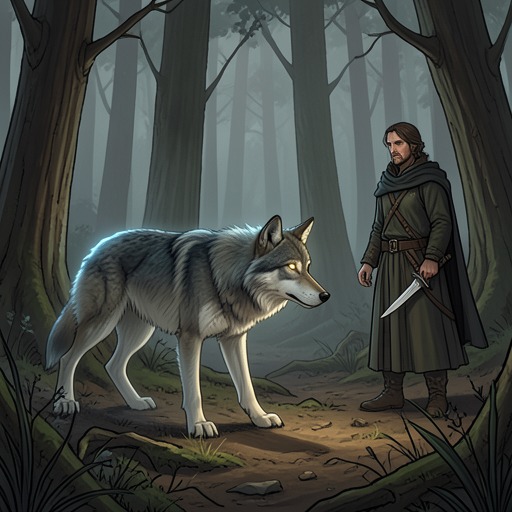
St. Yrieux is a threshold between settled society and the forest. Within the town, rumor and communal storytelling impose meanings on uncertain events; beyond it, hunters move through mountains and woods where ordinary wolves, rare white wolves, and imagined Wehr-Wolves cannot easily be distinguished. Its location makes the supernatural credible without requiring every animal encounter to be supernatural. A white wolf can lure a hunter upward into a dangerous mountain clearing, while the town’s earlier stories about wolves’ preference for human flesh provide the cultural grammar through which violence is recognized.
The town also gives exile a social form. Gaspar de Marcanville’s concealment depends on its remoteness, its inattentive inhabitants, and the decayed Chateau, yet the same isolation exposes Adéle de Marcanville to the fears that surround the woods. St. Yrieux is therefore both sanctuary and danger: it hides a displaced family from political enemies while placing them inside a community prepared to believe that monstrous forces are living next door.
More broadly, St. Yrieux condenses the book’s account of werewolf tradition. The wider history moves from superstition into folklore, legend, poetry, and nineteenth-century short fiction; the town shows that process operating at ground level. Local gossip, frightened households, learned citations, forest geography, and unexplained animal behavior all cooperate in making the Wehr-Wolf a social reality before any final proof can settle the matter. The place is not simply where the legend occurs. It is the mechanism by which the legend is produced, circulated, and believed.